

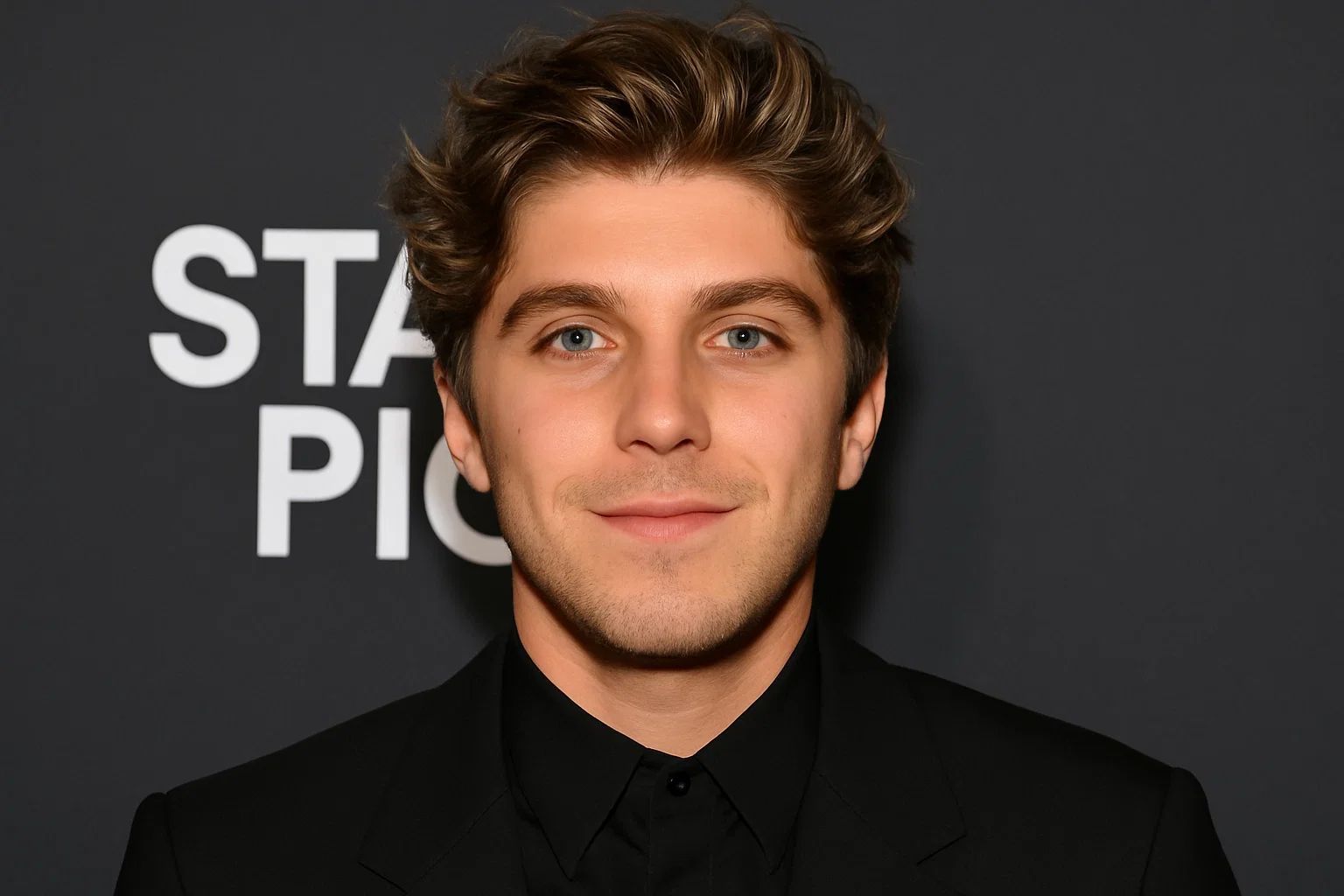
Key Takeaways:
- The “Tiny Apartment” Catalyst: Gage didn’t wait for a big break; he accidentally created one when a director insulted his home on a hot mic, and he had the guts to post it.
- The HBO Heavyhitter: He turned a small role as Dillon in The White Lotus into a career-defining moment, proving he’s fearless when it comes to taboo on-screen moments.
- Genre-Hopping: From the toxic romance of Netflix’s You to the terrifying gore of Smile 2 (2024) and Companion (2025), he refuses to be typecast.
- Raw & Real Author: His 2025 memoir, I Wrote This for Attention, strips away the PR veneer to talk about BPD, childhood trauma, and the messy reality of fame.
- Tabloid Rollercoaster: His lightning-fast marriage and divorce from Chris Appleton proved he lives life as loudly as he acts.
Also Read: David Jonsson and Archie Madekwe
Lukas Gage is a weird anomaly in Hollywood right now, and I mean that as a massive compliment.
In an era where every young actor feels media-trained to within an inch of their life, terrified of saying the wrong thing, Gage virtually sprints toward the chaos. I remember the exact moment he landed on my radar. It wasn’t a red carpet photo. It wasn’t a glossy magazine spread. It was a grainy, awkward video on Twitter back in 2020. I was sitting on my couch, doom-scrolling like the rest of the world, and there was this blonde kid getting roasted by a director for his “tiny apartment.”
Most guys would have folded. I know I would’ve probably stuttered an apology and logged off. But Gage? He smirked. He fired back with this perfect mix of self-deprecation and confidence. That was the moment I knew: this guy is going to be huge. Fast forward to late 2025, and he’s everywhere. He’s survived the meat grinder of HBO dramas, became a scream king in horror hits like Smile 2, and even wrote a memoir that actually says something. He’s the anti-heartthrob heartthrob. But how did he get here? And why can’t we stop watching him?
Wait, Where Did He Even Come From?
It feels like Lukas Gage just materialized out of thin air to steal scenes in Euphoria, but the reality is way less glamorous. He was born on May 28, 1995, in San Diego. He didn’t come from some dynastic acting family where roles were handed down like heirlooms. The guy grinded. I have serious respect for actors who do the dirty work before the fame hits, and Gage paid his dues in the most embarrassing way possible: commercials.
We’re talking wart removal commercials. Seriously.
He spent his childhood and teen years in Southern California, close enough to the dream to smell it but far enough away to feel like an outsider. In his book, he talks about this feeling of not fitting in, of being a chameleon. That resonates with me. High school is brutal, and for Gage, “acting” wasn’t just a hobby; it was a survival tactic. He learned to read rooms, to shift his personality to survive social hierarchies. You can see that survival instinct in every character he plays now.
Before the big hits, he was doing the rounds in projects like Scouts Guide to the Zombie Apocalypse and American Vandal. If you haven’t seen American Vandal, stop reading this and go watch it. It’s brilliant. Gage wasn’t the lead, but he was there, putting in the reps. He wasn’t waiting for permission to be an actor; he was just doing the work, one unglamorous gig at a time.
How Did a “Shitty Apartment” Launch a Career?
Let’s be real: talent matters, but in Hollywood, narrative matters more. And Lukas Gage seized his narrative by the throat in November 2020.
I still laugh when I watch that clip. Director Tristram Shapeero thought he was muted. He wasn’t. He started sighing about “these poor people” living in “tiny apartments.” It was so dismissive, so arrogant—the kind of Hollywood snobbery that usually happens behind closed doors.
Gage’s reaction was legendary. “I know it’s a shitty apartment. That’s why give me this job so I can get a better one.”
Boom.
He didn’t get mad. He didn’t cry. He made it a joke. He posted it, and the internet—which usually hates everyone—decided they loved him. Judd Apatow and January Jones were in the comments cheering him on. It was a masterclass in reading the room. He turned a moment of humiliation into a badge of honor. Casting directors who wouldn’t have looked twice at his headshot suddenly wanted to meet the kid with the quick wit. It proved he had thick skin. In this business, thick skin is worth more than a perfect jawline.
Why Was His Role in The White Lotus So Shocking?
If the Zoom video got him the meeting, The White Lotus sealed the deal. Season 1 was a cultural phenomenon. We were all obsessed with the class warfare at that resort. Gage played Dillon, a staffer who seemed pretty inconsequential at first. I didn’t think much of him in the first few episodes. Just another background character, right?
Wrong.
Then came the scene. You know the one. Murray Bartlett’s character, Armond, is spiraling out of control, drug-fueled and desperate, and pulls Dillon into his orbit. The rimming scene broke the internet. I remember watching it and literally dropping my remote. It wasn’t just that it was graphic; it was that it was on HBO, in a prestige drama, involving a character we thought was innocent.
Gage could have shied away from it. A lot of young actors want to be Captain America. They don’t want to be the guy getting his salad tossed in a hotel room. But Gage leaned into the grit. He understood that the scene wasn’t just for shock value; it was about power dynamics and corruption. By being willing to “go there,” he separated himself from the pack of generic pretty boys. He showed he was an actor’s actor, willing to sacrifice vanity for the story.
Is He the Best “Bad Boyfriend” on TV?
After White Lotus, Gage pivoted to Netflix’s You for Season 4, and man, did he nail the vibe of the “Golden Retriever Boyfriend” gone wrong. He played Adam Pratt, a wealthy expat in London.
On the surface, Adam was charming. He had the money, the looks, the parties. But Gage played him with this frantic, desperate energy underneath. You could tell something was off. He weaponized that charm. I’ve met guys like Adam—guys who smile too much because they’re hiding a mountain of insecurity and debt. Gage captured that perfectly.
And again, he didn’t shy away from the kink. The “golden shower” storyline was another viral moment. Gage approached it with a surprising amount of nuance. He didn’t play it for laughs; he played it as a desperate need for intimacy and degradation. It takes a lot of confidence to play a character who is essentially pathetic. Gage made Adam Pratt tragic, annoying, and deeply human all at once. It’s hard to hate a guy when you can see exactly why he’s so broken.
What the Hell Happened with Chris Appleton?
Okay, we have to talk about the marriage. This was a whirlwind even by Hollywood standards. I blinked in early 2023, and suddenly my feed was full of Lukas Gage and celebrity hairstylist Chris Appleton looking insanely good together. They were the “it” couple for about five minutes.
Then came the wedding. Las Vegas. Kim Kardashian officiating. Shania Twain singing. It was like a fever dream generated by a pop culture algorithm. Gage was wearing a fur coat, looking like a rockstar. It seemed fun, impulsive, and passionate.
But then, just as fast as it started, it imploded. Appleton filed for divorce by November.
Here’s why I respect Gage: he didn’t hide. He went on TV and called the marriage a “manic episode.” He admitted he was unhinged. He apologized to Shania Twain for wasting her time! That is hilarious. Most celebs would have their publicist issue a statement about “love and respect.” Gage just said, “Yeah, I was out of my mind.”
I’ve been through breakups. They suck. I can’t imagine going through a divorce in under a year with the entire world watching. His ability to laugh at his own mistakes makes him incredibly likeable. He’s not pretending to be perfect. He’s just a guy figuring it out, messy and loud, just like the rest of us.
Does He Even Care About Labels?
People have been obsessed with Gage’s sexuality for years. It’s kind of gross how much strangers feel entitled to know who an actor sleeps with. Because he played gay characters in White Lotus, Love, Victor, and You, people accused him of “queerbaiting.”
Gage’s response? “You don’t know my alphabet.”
That is such a boss line. He refused to be categorized. Recently, he’s been even more open, joking about being “10% straight” and still dating around. I love that he refuses to sit in a box. He seems to operate on vibes. He likes who he likes. By refusing to slap a definitive label on himself, he’s challenging the industry’s need to categorize everyone. He’s just living his life, and frankly, it’s none of our business, but he’s gracious enough to let us in on the joke.
Is His Memoir Actually Worth Reading?
Celebrity memoirs are usually trash. Let’s be honest. They’re ghostwritten vanity projects. So when I heard Gage was releasing I Wrote This for Attention in late 2025, I rolled my eyes.
I was wrong.
The book is actually good. Like, painfully good. He drops the persona and gets real about Borderline Personality Disorder (BPD). That is a heavy diagnosis to admit publicly. BPD is stigmatized as hell. For a young, successful guy to say, “I struggle with emotional regulation, I fear abandonment, I have manic episodes,” is brave.
He writes about his childhood trauma, his absent father, and the abuse he faced. It recontextualizes all his “crazy” acting choices. That chaos he brings to the screen? It’s not fake. It’s channeled. He’s turning his actual pain into art. Reading the book, I felt like I was listening to a friend confess their darkest secrets over a beer at 2 AM. It’s messy, it’s funny, and it’s heartbreaking.
Why Is He Suddenly a Horror Icon?
Just when we thought he was the dramedy king, Gage decided he wanted to be covered in blood. 2024 and 2025 have been his horror era.
Smile 2 was intense. I saw it in a crowded theater, and the tension was unbearable. Gage played his role with this terrifying physicality. He told Backstage that he worked with a movement coach to perfect the “stillness” and the “micro-movements.” It paid off. When he smiled that cursed smile, it wasn’t goofy; it was primal.
Then came Companion in early 2025. Sci-fi horror alongside Jack Quaid. Gage seems to thrive on high-octane emotion. Horror requires you to sustain fear for weeks on end. It’s exhausting. But Gage brings a frantic energy that sells the terror. He’s not the stoic hero; he’s the guy freaking out, which is exactly how I would be acting if a demon was chasing me. He makes the fear relatable.
What’s the Verdict on His Acting Style?
I’m a film nerd, so I like to analyze what actors are actually doing. Gage is interesting because he lacks vanity. He doesn’t try to look cool.
Watch him in Fargo. He played Lars Olmstead, a pathetic, brow-beaten husband. He changed his posture, his voice, his walk. He looked soft, weak. Compare that to the swagger of Adam in You or the manic energy of White Lotus.
He credits his improv background for this. He’s willing to try things in the moment, to fail, to look stupid. That’s rare. Most actors are so controlled. Gage feels dangerous on screen because you truly don’t know what he’s going to do next. He’s a character actor trapped in a leading man’s body. He reminds me of a young Sam Rockwell or Jim Carrey—guys who could be funny, scary, and heartbreaking all in the same scene.
How Does He Handle the “Internet Boyfriend” Curse?
The internet loves to chew people up. One day you’re the “Internet Boyfriend,” the next day you’re cancelled. Gage has held onto the title longer than most because he’s in on the joke.
When people thirst over him, he winks back. When people mocked his hair or his divorce, he mocked himself first. He has this self-awareness armor. He knows the fame game is silly. He knows he’s lucky to be there. In his book, he talks about feeling “unearned” sometimes, about the impostor syndrome of going viral for a Zoom clip rather than a monologue.
But that humility is exactly why he stays popular. He talks about cinema history, about the craft, about mental health. He’s not just a pretty face; he’s a student of the game.
What’s Next for Lukas Gage?
So, what happens now? He’s turned 30. He’s divorced. He’s a published author. He’s a horror star.
Honestly, I think he’s just getting started. He’s hinted at wanting to write and direct. Given how strong his voice is in his memoir, I’d watch a movie written by him in a heartbeat. He’s mentioned wanting to work with directors like Gregg Araki—filmmakers who are queer, chaotic, and punk rock. That is exactly where he belongs.
Lukas Gage isn’t just a viral moment anymore. He’s a force. He’s proven he can take a punch—whether it’s from a snobby director, a failed marriage, or a demon in a horror movie—and come up smiling. And yeah, maybe he wrote his book for attention, but you know what? He earned it.
Explore more about Lukas Gage’s filmography on IMDb
FAQs – Lukas Gage
How did Lukas Gage first gain public attention?
Lukas Gage gained public attention when a director insulted his tiny apartment on a hot mic, and he posted the clip, turning a moment of humiliation into a badge of honor.
What was significant about Gage’s role in The White Lotus?
Gage’s role as Dillon in The White Lotus was shocking because his character was involved in a controversial scene, demonstrating his willingness to take risks and lean into gritty, real acting.
How does Lukas Gage handle his public image and tabloid fame?
Gage handles his fame with self-awareness and humor, openly discussing his mistakes, relationships, and mental health, which makes him more relatable and likeable.
What is unique about Lukas Gage’s acting style?
Gage’s acting style is characterized by his lack of vanity, improvisation skills, and willingness to try unexpected things, making him unpredictable and deeply versatile.
Why has Lukas Gage become a horror icon recently?
Gage has become a horror icon due to his intense and physical performances in films like Smile 2 and Companion, where he brings a frantic energy and relatable fear to the genre.