
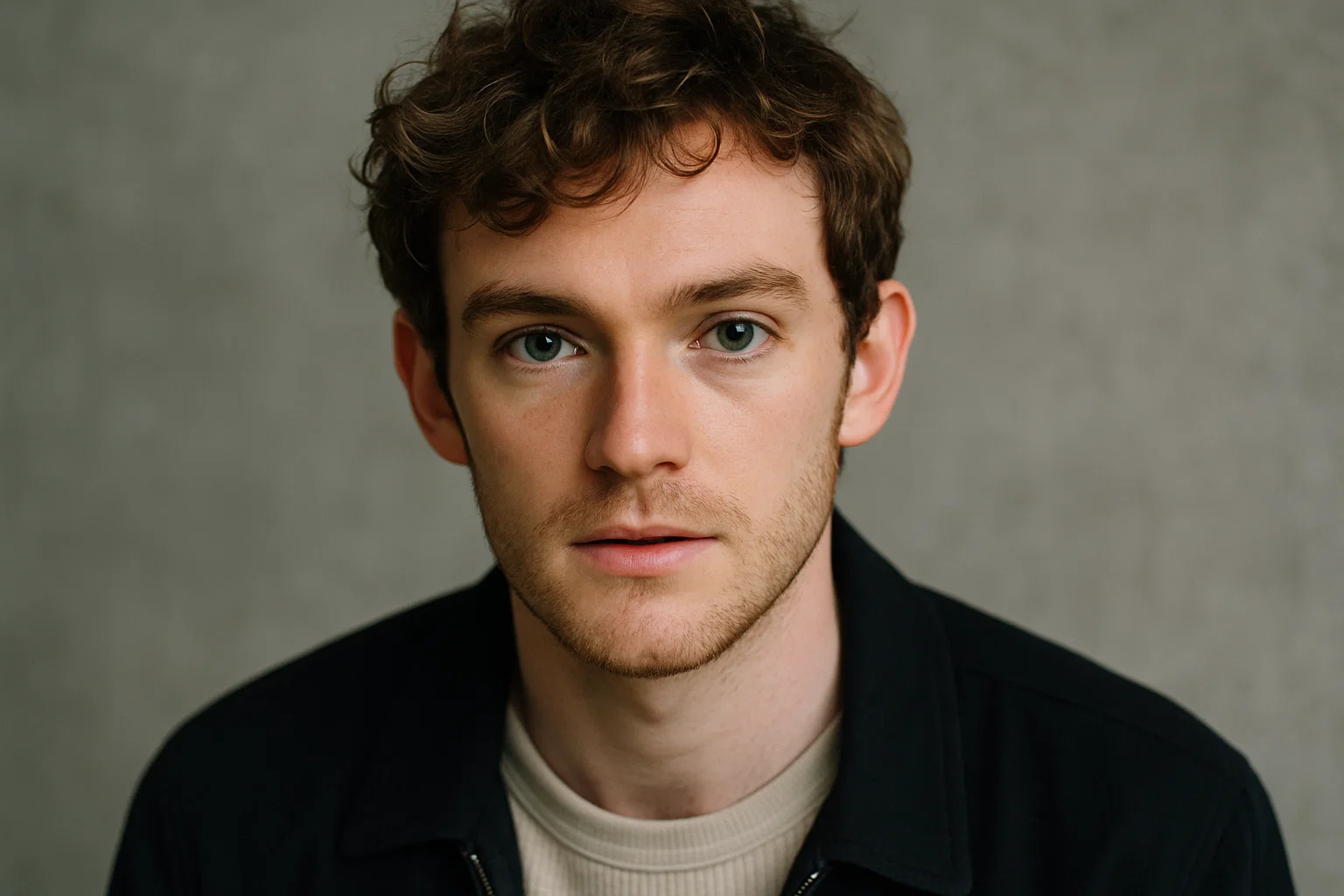
If you have been paying attention to the landscape of television over the last decade, you have likely noticed a specific face popping up in the most unexpected places. Maybe you saw him throat-punch a choir boy in a surreal Netflix mystery. Maybe you caught him charming the life out of a fantasy kingdom while wearing a privateer’s coat. Or, more recently, you might have seen him stepping into the blood-spattered shoes of America’s favorite serial killer. That face belongs to Patrick Gibson.
He isn’t just another name on the endless list of “rising stars” coming out of Dublin. There is something different happening here. Gibson has a habit of picking roles that shouldn’t work—characters that are unlikable, risky, or burdened by massive expectations—and somehow making them the most compelling part of the show. He is quietly building one of the most interesting resumes in the industry, transitioning from high-concept indie darlings to massive franchise juggernauts without breaking a sweat.
We are going to dig into who this guy actually is. Not just the Wikipedia bullet points, but the weird stories, the risky career moves, and the specific acting choices that make him stand out in a crowded field.
Also Read: David Jonsson and Archie Madekwe
Key Takeaways
- The Dublin Pivot: Gibson swapped a Philosophy degree at Trinity College for a script, leaving university halfway through to shoot The OA.
- The Anti-Hero Specialist: He broke out playing Steve Winchell, a character designed to be hated, and turned him into a fan favorite.
- Filling Big Shoes: He is currently tackling the impossible task of playing a young Michael C. Hall in Dexter: Original Sin.
- Method Madness: To prepare for Dexter, he literally stalked a stranger in Miami until he got caught—a story that proves his dedication (and slight insanity).
- Fantasy Charm: Won over a skeptical book fanbase as Nikolai Lantsov in Netflix’s Shadow and Bone.
- Digital License to Kill: He is the new James Bond… technically. He provides the voice and motion capture for the upcoming 007 First Light game.
Who Is the Man Behind the Characters?
Patrick Gibson’s story doesn’t start in a Hollywood nepotism factory. It starts in Westminster, London, where he was born on April 19, 1995, before his family moved back to Ireland. He grew up bouncing around Greystones, Stillorgan, and Donnybrook. It sounds idyllic, and by all accounts, it was a fairly grounded upbringing. His dad was an actor, and his mum worked in marketing, so he had a window into the creative world without being suffocated by it.
But here is the interesting part: he didn’t just leap straight into drama school. He went to Gonzaga College and then enrolled at Trinity College Dublin. His major? Philosophy.
You have to wonder what kind of actor that produces. Most 20-year-olds in the industry are obsessing over headshots and Instagram followers. Gibson was studying Plato and existentialism. That academic background bleeds into his work. Watch his interviews; he doesn’t just talk about “feeling the emotion.” He deconstructs the psychology of his characters with an analytical edge that feels very… academic.
In 2016, he faced a massive crossroads. He was halfway through his degree when he landed a role in a show with zero hype and a bizarre premise called The OA. He had to choose: finish the degree or fly to America to play a drug-dealing bully. He chose the bully. He packed his bags, left Trinity, and never looked back. It was a gamble that defined his entire adult life.
How Did The OA Turn a Bully into a Hero?
Let’s talk about Steve Winchell. If you watched The OA, you remember the visceral reaction you had to Steve in the first episode. He was awful. Violent, angry, toxic—a lost boy lashing out at the world. It is incredibly difficult for an actor to play a character that repulsive and still keep the audience watching.
Gibson didn’t play Steve for sympathy; he played him for truth. He understood that Steve’s rage wasn’t just “being a bad kid.” It was panic. It was the terrified reaction of a young man who felt worthless.
There is a story about his casting that sums up the chaos of that time. His agent woke him up—he was deep asleep—to tell him about the role. He sent in a tape while still shaking off the grogginess. When he flew to New York to meet creators Brit Marling and Zal Batmanglij, he was terrified. They are intense creators, known for secrecy. He walked into that room not fully knowing what the show was even about.
The physical demands were just as weird as the emotional ones. Remember the “Movements”? Those interpretative dances that opened interdimensional portals? Gibson spent hours with choreographer Ryan Heffington (who did Sia’s “Chandelier” video) perfecting those motions. He wasn’t just learning choreography; he was learning a physical language.
By the end of the series, Steve Winchell had one of the best redemption arcs in modern TV history. When he runs after the ambulance in the season finale, screaming “Take me with you!”, it breaks your heart. That shift—from throat-punching bully to desperate believer—is all Gibson. He earned that Rising Star Award at the 2017 IFTAs not because he was the loudest person on screen, but because he was the most human.
Why Was the Nikolai Lantsov Casting So Controversial?
Book fans are terrifying. If you get a character wrong, they will tear you apart on Twitter before the trailer even drops. When Gibson was announced as Nikolai Lantsov for Shadow and Bone, the Grishaverse fandom was on high alert. Nikolai is a prince, a pirate, a wit, and a politician. He is charming, arrogant, and deeply insecure all at once.
Gibson walked right into the fire. He made a comment in an interview comparing Nikolai to “Tony Stark,” highlighting the character’s ego and tech-savvy nature. The internet exploded. People debated whether he “got” the character.
But then the show aired.
Gibson didn’t just play Nikolai; he had fun with him. He captured that specific swagger—the “Sturmhond” persona—without making it look like a costume. The chemistry he had with the cast was electric. He managed to deliver lines that could have been cheesy (“I am not a pirate, I am a privateer”) with a wink and a smile that disarmed the critics.
He brought a vulnerability to the role that wasn’t explicitly on the page. You could see the wheels turning behind his eyes, calculating every political move while cracking a joke. He won over the book purists, which, frankly, is harder than winning an Oscar.
Is He Crazy for Playing Dexter Morgan?
This is the big one. The career-maker or the career-breaker. Dexter is sacred ground for a lot of TV fans. Michael C. Hall’s performance is so specific, so iconic, that the idea of anyone else playing that character feels wrong.
When Gibson signed on for Dexter: Original Sin to play the college-aged version of the serial killer, the skepticism was palpable. How do you mimic a performance that is defined by its lack of emotion?
Gibson went fully method. He didn’t just watch old tapes. He tried to get inside the head of a predator. He told a story recently that is both hilarious and slightly disturbing. To prepare for the role, he was in Miami and decided he needed to know what it felt like to watch someone without them knowing.
So, he picked a stranger on the street and started following them.
He tailed this poor unsuspecting person for about an hour, trying to blend in, trying to feel that specific tension of the hunt. It was going well until the stranger stopped, turned around, and made eye contact. Gibson panicked. The “predator” facade crumbled immediately, and he had to awkwardly bail before the cops got called.
It’s a funny story, but it shows how seriously he takes the craft. He wasn’t satisfied with just putting on a wig and doing a voice. He wanted the psychology. Critics have noted that he nails the “Dark Passenger” stare—that dead-eyed look Dexter gets when the mask slips. He isn’t doing an impression of Michael C. Hall; he is playing the version of Dexter that hasn’t fully learned how to fake being human yet. It is awkward, creepy, and weirdly charming.
Can He Handle a Sword as Well as a Gun?
Before he was tracking killers or traveling dimensions, Gibson was cutting his teeth in the period drama circuit. It is a rite of passage for UK and Irish actors. You have to look good in a tunic.
In The White Princess, he played Perkin Warbeck. This is a fascinating historical figure—a man who claimed to be one of the lost Princes in the Tower. Was he a king or a conman? Gibson played the ambiguity perfectly. He has a face that works in history; he looks like he could belong in a Renaissance painting, but his energy is modern.
He described the sword-fighting on that show as “every kid’s dream.” It was a break from the heavy emotional lifting of his other roles. He just got to run around castles and fight people.
Then there was Tolkien. He played Robert Gilson, one of J.R.R. Tolkien’s best friends. It was a smaller role in an ensemble piece, but it was vital. He had to convey the deep, brotherly love of that friend group before World War I ripped them apart. It showed he plays well with others. He doesn’t need to be the lead to be memorable. He can support a scene, adding warmth and tragedy without stealing the focus.
Is Patrick Gibson Actually Funny?
With all these heavy roles—serial killers, bullies, tragic soldiers—you might expect Gibson to be a brooding artist type in real life. The reality is quite the opposite. He is disarmingly normal and actually pretty funny.
He appeared on The Kelly Clarkson Show recently and somehow ended up in a heated debate about chocolate milk. Not world politics, not the craft of acting—chocolate milk. He has very specific opinions on the best Irish brands. It was such a mundane, human moment that it instantly endeared him to the audience.
He also has zero ego about his past. He happily shares photos of his “childhood rock band” days. You know the vibe: terrible haircuts, skinny jeans, trying way too hard to look cool. Most actors burn those photos. Gibson puts them on national television.
He has that self-deprecating Irish wit. When discussing his role in The White Princess, he joked about how difficult he found it to play a “nice” character compared to the sociopathic Steve Winchell. “I’m not sure if that’s a sign that I’m a dick or not,” he laughed. It’s hard not to like a guy who questions his own moral compass for a laugh.
What About James Bond?
You cannot talk about a British or Irish actor under 35 without the “James Bond” conversation coming up. But Gibson has sidestepped the tabloids and gone straight to the source. He is James Bond.
He is starring in the new video game 007 First Light. This isn’t just standing in a booth reading lines. It is full motion capture. He is doing the stunts, the facial expressions, the whole performance.
This is a massive deal. Video games are the new blockbusters. By locking down this role, he gets to be Bond without the ten-year contract that ties him down to one film franchise. He gets the prestige of the character but keeps his freedom to go play weird indie roles. It positions him as a leading man in a way that films haven’t quite yet.
What Is Next for Him?
Patrick Gibson is in the sweet spot of his career. He is old enough to handle complex, adult roles like Dexter, but young enough to still have that “rising star” hunger.
He has avoided the trap of being typecast. He isn’t just the “villain” or just the “love interest.” He is the guy you call when you need someone who can be scary and heartbreaking in the same scene.
He is balancing a legacy TV show, a massive video game franchise, and likely a dozen scripts we don’t know about yet. He is doing it all while maintaining a low profile, keeping his head down, and doing the work.
If you haven’t done a deep dive into his filmography, you should. Go watch What Richard Did for a look at his early Irish work. Check out The OA to see him explode onto the scene. And definitely watch Dexter: Original Sin to see if he pulls off the impossible.
For a look at what the critics think, you can always check his profile on Roger Ebert.
Patrick Gibson isn’t coming. He is already here. And if his track record is anything to go by, he is going to be messing with our heads for a very long time.
FAQs – Patrick Gibson
What is the background of Patrick Gibson and how did he start his acting career?
Patrick Gibson was born in Westminster, London, and grew up in Ireland. He studied philosophy at Trinity College Dublin before leaving university halfway through to pursue acting, landing his first major role in ‘The OA,’ which marked the beginning of his professional acting career.
How did Patrick Gibson transform his role in ‘The OA’ from a hated character to a fan favorite?
Gibson played Steve Winchell in ‘The OA,’ a character initially designed to be unlikable, and approached him with honesty and depth, showing his rage as panic and vulnerability. His authentic portrayal and physical commitment, including mastering interpretative dances, helped turn the character into a compelling and relatable figure.
Why was Patrick Gibson’s casting as Nikolai Lantsov in ‘Shadow and Bone’ controversial, and how was his performance received?
Fans of the book series were highly protective and skeptical of Gibson’s casting as Nikolai Lantsov. However, his performance captured the character’s charm, wit, and vulnerability, winning over critics and fans alike with his energetic delivery and authentic chemistry with the cast.
What is Patrick Gibson’s involvement with the James Bond franchise?
Patrick Gibson is the voice and motion capture actor for the upcoming video game ‘007 First Light,’ which involves performing stunts and facial expressions, allowing him to embody James Bond in a groundbreaking, immersive format outside of traditional films.
How did Patrick Gibson prepare for his role as young Dexter Morgan in ‘Dexter: Original Sin’?
Gibson took a fully method approach, including watching old tapes of Michael C. Hall and physically stalking a stranger in Miami to understand the predator’s mindset, which helped him deliver a dead-eyed, creepy, and convincing portrayal of Dexter Morgan.